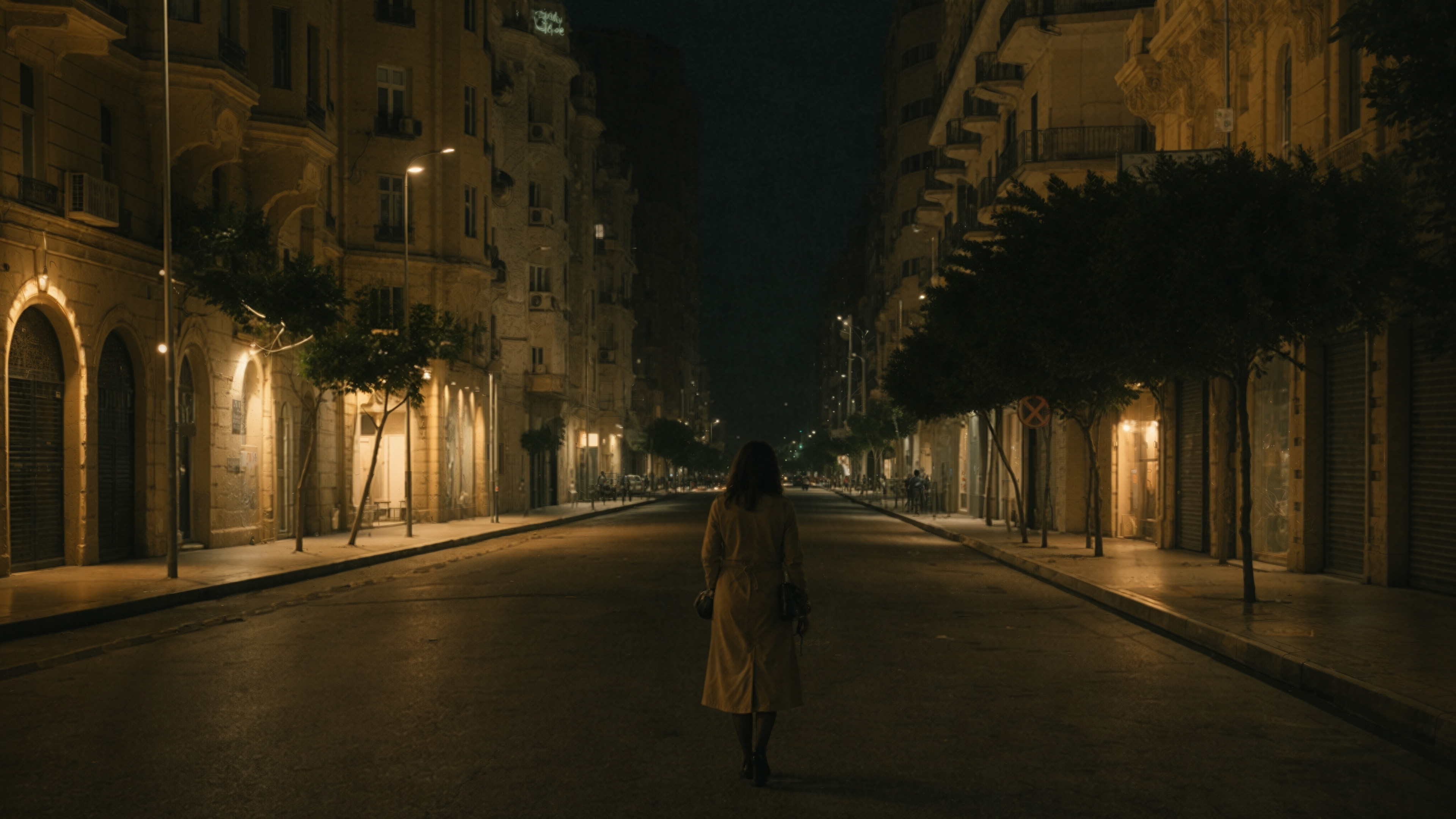
A City That Was Always Awake
Cairo has never really slept. It stretches, breathes, hums. From late-night ahwas in Downtown to women grabbing a quiet coffee after work, the city has always offered something constant: movement, noise, and witnesses.
The city didn’t rely on silence, it thrived on presence.
There was always someone even late at night, a group of friends lingering on the sidewalk, a passing car, a stranger smoking outside a closed shop that wasn’t really closed.
Cairo existed in layers. Even when it slowed down, it never fully stopped.
Because sometimes, safety isn’t about walls or locks, it’s about being seen, about knowing you’re not the only one moving through space, about walking in a city that refuses to go quiet.
And still, women were in danger.
Let’s not rewrite reality, harassment existed in crowded streets, discomfort existed in taxis, fear existed in broad daylight.
Cairo has never been an easy city for women to navigate but its chaos did something subtle, something often overlooked: it made isolation harder.
Now, The City Is Switching Off Early
With the newly enforced 9 PM closure of shops, cafes, and public venues, Cairo is being asked to adopt a rhythm that feels unfamiliar.
By 9:30 PM, something shifts, shutters come down faster, lights go out sooner, streets that once carried life begin to empty in a way that feels abrupt.
Not gradual, not organic but immediate.
On paper, the reasoning is clear, an energy crisis requires action. Less electricity consumption, more control over resources, a system trying to stabilize itself.
And in that context, early closures make sense but cities are not just systems.
They are lived in, they are felt.
And when you change the rhythm of a city like Cairo, you don’t just change how it looks.
You change how it feels to move through it.
Darkness Changes Behavior
There is a difference between a street at 11 PM that is still alive and a street at 9:30 PM that has already emptied.
It’s not just visual, it’s behavioral. People leave faster. movement reduces, lingering disappears.
The casual presence that once filled space even without purpose is gone.
And when that happens, something else shifts:The balance between visibility and vulnerability.Because visibility is not just about light, it’s about people.
Women Don’t Experience This Shift Equally
For some, early closures are inconvenient. For others, they are transformative.
Women in Cairo already navigate the city differently, not because they want to but because they have to.
Every outing comes with calculations: When should I leave? Which route is safer? Is this street usually busy at this hour? Should I take a car or walk? Who can I call if something feels off?
These decisions are constant, quiet, and automatic. They are not reactions, they are survival patterns.
And those patterns were built around a city that stayed awake.
When the City Gets Dark Earlier, Those Patterns Break
The problem isn’t just that Cairo is getting darker. It's getting darker earlier than expected.
The mental map women rely on, the one that says “this street is usually fine at this time” starts to fail.
Because now, the same street is emptier, is quieter, has fewer lights, has fewer people and that changes everything.
Not in theory, in practice.
What Darkness Actually Does
Darkness is often treated as a visual condition.
But in cities, it’s social. It affects: Who chooses to stay, who decides to leave, who feels comfortable moving, who becomes visible and who doesn’t
When a street is well-lit and active, there is an unspoken layer of accountability
People are around, something can be noticed, something can be interrupted.
But when that disappears, the environment changes.
Not dramatically but enough.
Enough to shift behavior, enough to shift risk.
The Relationship Between Visibility and Safety
Cairo has never been defined by safety but it has been defined by presence, and presence creates friction.
It makes it harder for harm to happen unnoticed, it makes it easier for someone to intervene. It creates a sense, even if fragile, that you are not alone.
Take that away,and something important is lost.
Not safety but protection through visibility.
The Reality Women Already Live With
Women in Cairo already carry a heightened awareness of space.
They notice: Who is walking behind them , which areas feel off, when a street becomes too quiet, when to speed up, when to avoid eye contact, when to call someone just to stay connected
These are not overreactions, they are responses to lived experience.
So when the city changes, when it becomes darker, emptier, quieter that awareness intensifies
Because the environment is giving different signals and those signals matter.
The Numbers We Can’t Ignore
Harassment in Egypt is not an isolated experience, it is a widespread reality. Multiple studies over the years have consistently shown that the vast majority of Egyptian women have been subjected to some form of sexual harassment in public spaces.
A landmark study by UN Women found that over 99% of women surveyed in Egypt reported experiencing harassment at least once in their lifetime, ranging from verbal comments and unwanted attention to physical assault.
Another study by Egypt’s Demographic and Health Survey (EDHS) indicated that a significant percentage of women regularly face harassment in streets, public transportation, and crowded areas. These numbers don’t point to rare incidents, they reflect a normalized, everyday experience. This isn’t the exception. This is the environment women are already navigating.
More Than Just Physical Risk
Even in moments where nothing happens, the impact is real.
Because safety is also psychological.
Walking through a dark, empty street creates: Tension, alertness, a constant sense of anticipation
Every sound feels louder, every step feels faster, every shadow feels heavier.
It’s not just about what could happen, it’s about what the environment is telling you might happen.
A City That Feels Different
Nothing about Cairo’s structure has changed.
The same streets exist.
The same buildings stand.
The same routes connect.
But the experience of moving through it has shifted.
And for women, that shift is immediate.
It’s felt in the first خطوة outside.
In the first dark corner.
In the first moment of realizing:
This doesn’t feel like the same city.
If You Need Support
If you or someone you know is in danger or feels unsafe,
you can contact the National Council for Women’s hotline at 15115, which provides confidential legal and psychological support.
Because safety is not just about prevention, it’s also about knowing where to turn when something feels wrong.
Reflection
Cairo was never fully safe.
But it was alive.
Alive enough to create movement. Alive enough to reduce isolation. Alive enough to make a presence felt.
Now, as the city goes dark earlier, we’re not just losing light.
We’re losing something less visible. Something harder to measure.
Something women have always relied on (even without naming it).
The feeling that you are not alone.